
Build a safe floor from the bottom up
Best Substrate for an Axolotl Tank
Compare fine sand, bare glass, and large smooth tile or slate, then choose the option that fits your axie’s size and the maintenance routine you can actually keep.
Skip gravel and any loose stone your axolotl could swallow
Axolotls pull food into the mouth with water. Gravel can come with it and may cause an obstruction. If a decoration or stone is not clearly too large to swallow, I do not put it on the tank floor.
The straightforward answer
Fine sand or a bare bottom works for most axolotl tanks
Those are the two options supported most consistently by species-specific veterinary and husbandry guidance. Large smooth tile or slate can also work when it is truly aquarium safe, stable, easy to clean, and impossible to swallow.
There is no prize for choosing the most complicated floor. A clean bare-bottom tank with a mature filter is safer than a beautiful substrate that traps waste or creates an ingestion risk.
Why particle size matters
Feeding behavior can bring substrate into the mouth
Axolotls do not chew food the way we do. They open the mouth quickly and pull in food with surrounding water. Anything loose near that food may be swallowed too.
In the axolotl community, people debate which exact grain size is safe. I take the conservative route. I have seen enough cases of animals harmed by swallowed gravel that I do not see a reason to gamble with it.
Fine sand can also be swallowed in small amounts, so “fine” does not mean risk free. Animal size, particle shape, the amount swallowed, feeding method, water quality, temperature, and gastrointestinal health can all affect the outcome.
Option one
Fine aquarium sand
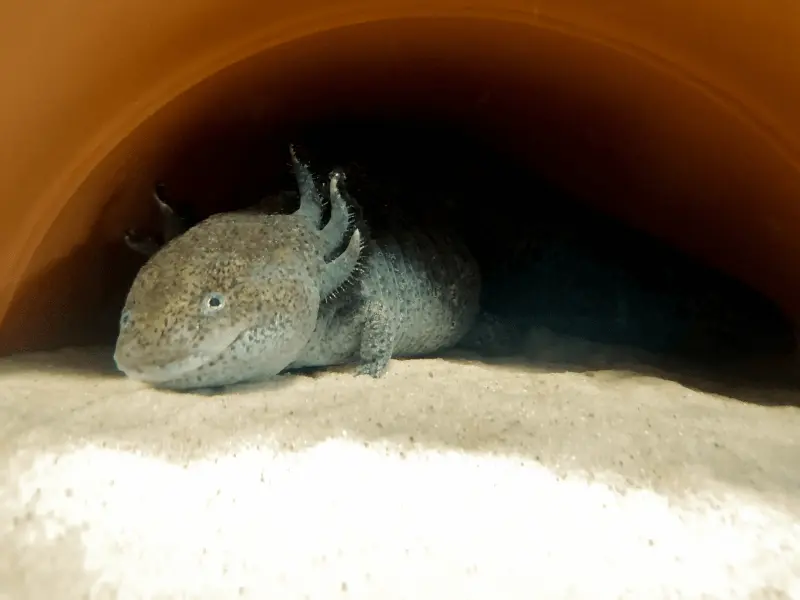
Sand gives the aquarium a natural look, creates a textured walking surface, and can anchor some plants. Waste usually remains visible on top when the layer is not overly deep, which makes spot cleaning with a turkey baster or narrow siphon easier.
I personally choose smooth aquarium sand with grains smaller than about 1 mm. That is my conservative shopping rule, not a scientifically proven line where every smaller grain becomes safe and every larger grain becomes dangerous. Check the actual product description because words such as “fine,” “river,” and “natural” are not standardized.
- The axolotl is large enough for sand to be an appropriate choice
- The grains are fine, smooth, clean, and aquarium safe
- The layer is easy to siphon and stir gently
- Food is offered with tongs or in a feeding area
- Very small juveniles are easier to monitor on bare glass
- Deep or compacted areas can hold debris
- Disturbed sand may temporarily cloud the water
- Coarse, sharp, or unknown sand is not a safe substitute
What I have used
My sand choice is simple and conservative
I have used Exo Terra Riverbed Sand because it is very fine and gives the tank a natural look. Whatever brand you choose, confirm the current grain size, ingredients, and aquarium directions instead of assuming that one product name guarantees safety.
Rinse new sand thoroughly before it enters the aquarium. If you are adding it to an established setup, prepare a safe temporary container for the axolotl, protect the mature filter media, and test ammonia and nitrite after the change.
Option two
Bare-bottom aquarium
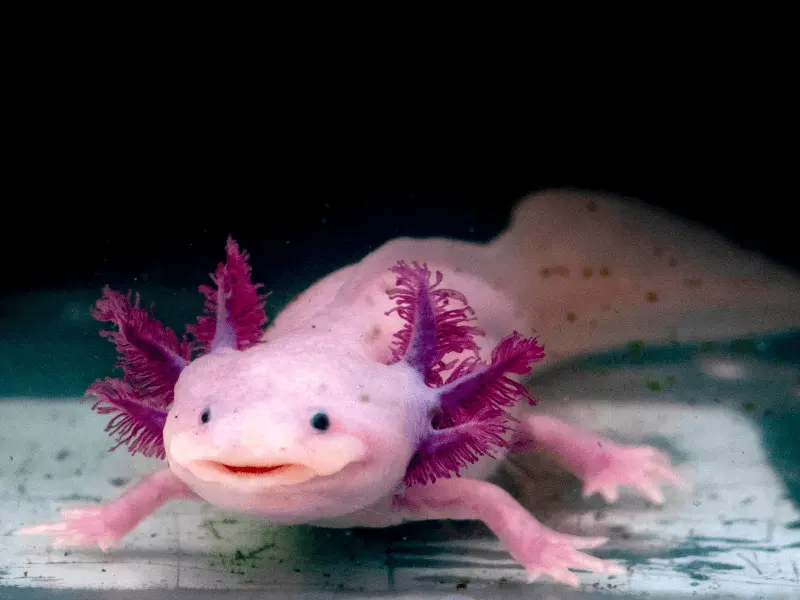
A bare bottom removes loose substrate from the feeding area and makes waste, leftovers, and changes in stool easy to see. That is especially useful for small juveniles, quarantine, recovery, and keepers who want the simplest cleaning routine.
The glass can look stark, and it provides less surface area than sand. That does not mean the aquarium cannot cycle. The filter should hold the main biological media, and bacteria will also colonize other wet surfaces.
- No loose substrate to swallow
- Fast spot cleaning
- Easy observation of food and waste
- Simple to rearrange hides and equipment
- The smooth glass may provide less traction
- Reflections can be visually distracting
- Rooted plants need pots or another anchor
- Every hide still needs a smooth, stable base
Option three
Large smooth tile or slate
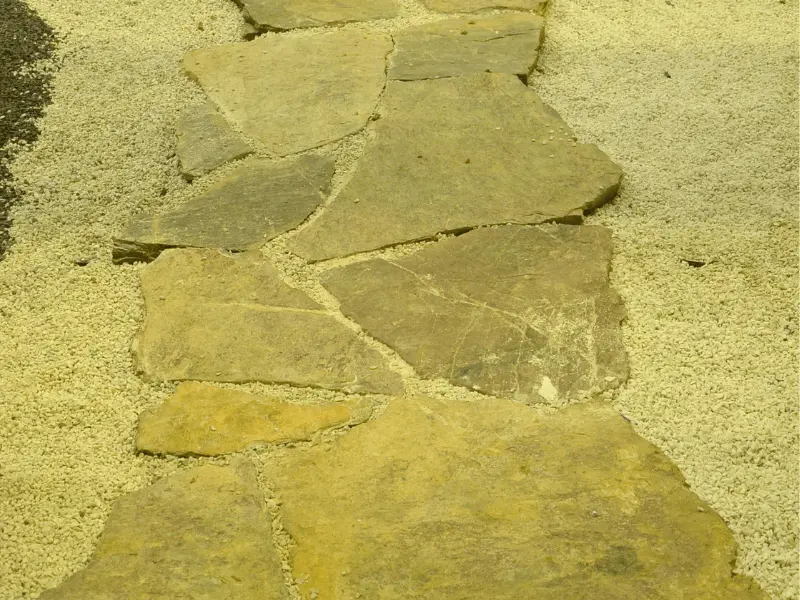
Large flat pieces can add color and texture without covering the floor in swallowable gravel. I like slate for its natural look, but the material must be inert, stable, and much too large for the axolotl to move or ingest.
Check every edge with your fingers. Do not stack pieces where they can shift or pinch an animal. Closely spaced pieces may collect waste in the seams, so make sure the complete layout can be siphoned without frequent disruptive removal.
- Firm walking and feeding surface
- Natural appearance without loose gravel
- Plants can be attached or placed in pots
- Large pieces cannot be swallowed
- Sharp or chipped edges
- Unstable stacks and hidden gaps
- Stone that changes water chemistry
- Coatings, sealers, grout, or adhesive not rated for aquariums
Affiliate disclosure: The following is an affiliate link. As an Amazon Associate I earn from qualifying purchases. Compare natural slate aquarium stones.
Materials I leave out
Avoid loose, sharp, difficult-to-clean, or chemically uncertain floors
I understand the temptation to copy a planted aquascape or use material already sitting in the garage. For an axolotl, the safe choice has to account for suction feeding, delicate skin and gills, cool water, and the amount of waste the animal produces.
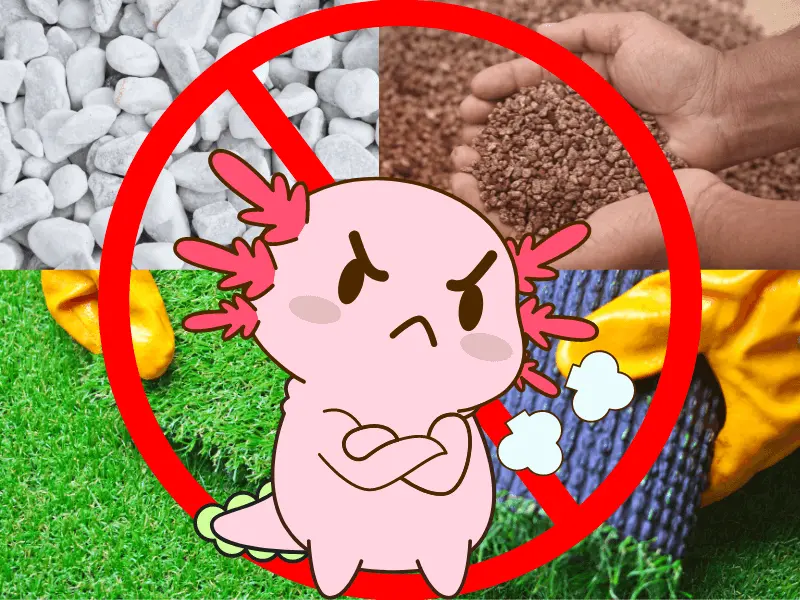
Gravel and small pebbles
Axolotls use suction to eat, so loose pieces can enter the mouth with food. A swallowed stone can become a gastrointestinal obstruction.
Aquasoil and loose planting media
Granules can be swallowed, break down into debris, and alter water chemistry. Some products also contain nutrients or additives that were not designed for axolotls.
Artificial grass or aquarium carpet
Fibers and seams can trap waste, fray, or create difficult cleaning areas. Materials and adhesives not rated for permanent aquarium use add another unknown.
Sharp, painted, or unknown materials
Avoid rough edges, flaking coatings, exposed metal, uncured adhesive, and stone that may change hardness or pH unless its aquarium safety is confirmed.
Match the floor to the keeper and animal
Compare the practical tradeoffs
| Option | Ingestion risk | Cleaning | Plants | Best fit |
|---|---|---|---|---|
| Fine aquarium sand | Lower than gravel, but not zero | Spot clean the surface and prevent deep debris pockets | Can anchor hardy rooted plants | Suitable juveniles and adults when chosen carefully |
| Bare bottom | No loose floor material | Easiest waste visibility and removal | Use pots, decor, or floating plants | Small juveniles, quarantine, recovery, and simple setups |
| Large tile or slate | Low when pieces are impossible to swallow | Easy surfaces, but seams can collect waste | Attach or pot plants | Keepers who can verify and finish every piece safely |
Plants do not require aquasoil. Many axolotl-friendly species can be attached to wood or stone, placed in pots, or floated. See my axolotl aquarium plant guide for low-light options.
Install it before the animal arrives
Set up and maintain the floor safely
- 1Inspect the material
Confirm that it is aquarium safe, free from additives, smooth, and appropriate for the animal’s size.
- 2Rinse thoroughly
Remove dust and loose debris without household soap or fragranced cleaner.
- 3Create a cleanable layout
Use a manageable sand layer or stable tile arrangement. Keep access around hides, the intake, and feeding area.
- 4Fill without blasting the floor
Pour onto a plate, bag, or smooth surface to reduce clouding and movement.
- 5Cycle and test
Run the complete aquarium through a fishless cycle before the axolotl enters. Test again after major floor changes.
- 6Spot clean every day
Remove visible waste and leftover food, then siphon the floor during regular partial water changes.
Changing an established tank? Prepare a safe temporary container, keep mature filter media wet and running when possible, avoid stirring dirty substrate around the animal, and monitor ammonia and nitrite closely afterward.
Common questions
Axolotl substrate FAQ
Does axolotl sand have to be smaller than 1 mm?
I use that as a conservative personal shopping rule, but it is not a scientifically proven universal cutoff. Choose genuinely fine, smooth aquarium sand and consider the animal’s size, feeding method, and health. Bare bottom remains the simplest option when you are unsure.
When can a juvenile move onto sand?
There is no single length that makes sand automatically safe. Very small juveniles are easier to feed and monitor on bare glass. Discuss the individual animal with an experienced aquatic veterinarian or responsible breeder, and upgrade only when you can choose fine sand and observe feeding and waste reliably.
Can I use play sand or pool-filter sand?
Do not rely on the product category alone. Grain size, shape, additives, dust, and quality vary by brand and batch. Use a product whose ingredients and particle characteristics you can verify, and avoid coarse or sharp material.
Will a bare-bottom tank lose its cycle?
Not when the aquarium has adequate mature filter media and the rest of the husbandry is sound. Substrate adds colonizable surface, but the filter should carry the main biological load. Test after removing an established substrate because any major change can disturb the system.
Can I cap aquasoil with sand?
I do not recommend it for a beginner axolotl setup. Digging, maintenance, and plant removal can expose the granules, while the active soil may change water chemistry. Pots and attached or floating plants are simpler alternatives.
What signs could suggest swallowed substrate is causing a problem?
Reduced appetite, repeated regurgitation, unusual swelling, abnormal buoyancy, weakness, or a persistent change in waste and behavior deserves attention. Test the water and contact an aquatic or exotic veterinarian. Do not force food, give laxatives, refrigerate the animal, or try another home remedy without professional direction.
Sources and further reading
- LafeberVet: Basic Information Sheet: Axolotl
- LafeberVet: Care of the Axolotl
- OATA: How to Look After Axolotls and Aquatic Frogs
- Ambystoma Genetic Stock Center: Food and Gravel Precaution
This independently written guide combines species-specific veterinary and husbandry sources with Pat’s direct aquarium experience. It cannot diagnose an animal or replace individual advice from an aquatic or exotic veterinarian.