
A long-term care commitment
How Long Do Axolotls Live?
A well-cared-for axolotl may be part of your life for a decade or longer. Here is what the lifespan estimates actually mean, how axolotls develop, and what you can do to support them at every stage.
The short answer
Axolotls commonly live about 10 to 15 years in human care. Some have reportedly lived as long as 20 years, but that should be treated as an exceptional possibility, not a promise. Genetics, early history, water quality, temperature, nutrition, injuries, disease, and access to veterinary care can all influence an individual life.
A range, not an expiration date
Plan for 10 to 15 years, then be ready for longer
LafeberVet lists an average lifespan of about 10 to 15 years and notes reports of individuals living up to 20. That makes an axolotl closer to a long-term companion than a short-lived aquarium novelty.
The honest answer for one animal is still “we cannot know exactly.” A lifespan range describes a population, not a countdown for an individual. An axolotl with excellent care may still develop a serious health problem, while another may outlive the usual estimate.
If you are deciding whether to bring one home, plan housing, food, cooling, maintenance, travel care, and veterinary savings for at least a decade. The ownership cost guide can help turn that commitment into a realistic budget.
From egg to older adult
Axolotl life stages are developmental, not exact birthdays
The stages below are useful descriptions, but they are not a universal calendar. Temperature, food, genetics, health, and housing affect growth and development. Two healthy axolotls of the same age may not be the same length.
- 1
Egg to hatching Egg and embryo
Development begins inside a jelly-coated egg. Temperature affects the rate, so a calendar date alone does not describe the embryo’s stage accurately.
- 2
Early growth Hatchling and larva
Newly hatched axolotls are tiny, fully aquatic, and dependent on appropriately sized moving foods. Growth can be rapid, but individuals do not all grow at the same rate.
- 3
Rapid development Juvenile
The limbs and digits finish developing, feeding changes, and body size increases quickly. Young animals of different sizes should not be treated as interchangeable.
- 4
Approaching maturity Subadult
The axolotl is approaching adult size and sexual characteristics may become easier to see. Maturity and finished growth are not the same milestone.
- 5
Mature, still aquatic Adult
A mature axolotl remains aquatic and keeps external gills, a tail fin, and other larval features. Healthy adults may continue to fill out after reaching sexual maturity.
- 6
Individual aging Older adult
There is no universally agreed pet-care age when every axolotl becomes a senior. Gradual individual changes matter, but illness should never be dismissed as old age.
AmphibiaWeb reports sexual maturity at roughly 8 to 15 months in laboratory conditions. Home-kept animals vary, and reaching maturity does not mean the axolotl has finished growing or should be bred.
Adults that keep larval traits
An adult axolotl has grown up, even though it keeps its gills
Axolotls are paedomorphic. They become sexually mature while retaining traits that most related salamanders have as larvae, including external gills and a tail fin. Their entire normal life cycle remains aquatic.
This is why the phrase “they never grow up” can be misleading. An adult is a mature animal, not a permanent baby. Its appearance reflects a different developmental strategy.
Rare spontaneous metamorphosis has been reported, but owners should never try to trigger it with hormones, iodine, heat, drying, or other environmental stress. Sudden loss of gills, major body changes, or attempts to leave the water deserve prompt veterinary guidance.
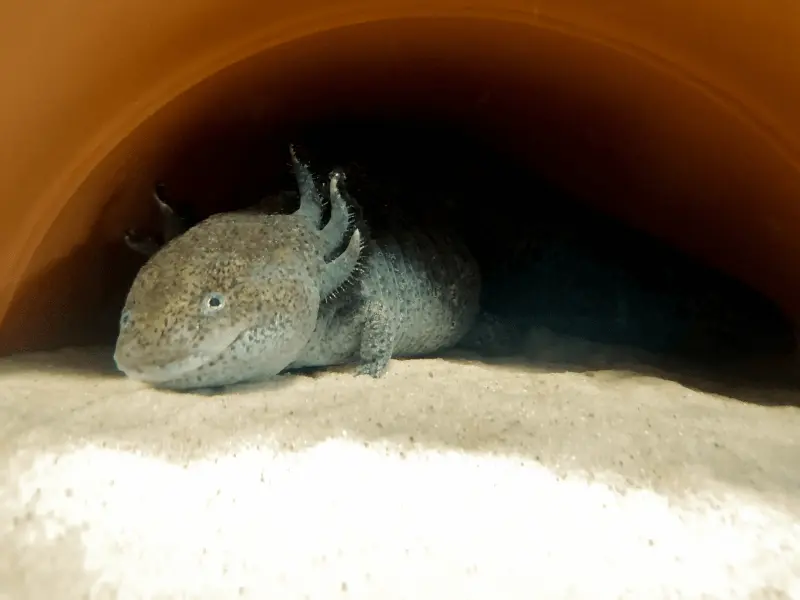
Growth is not a ruler-based clock
You usually cannot determine age from length alone
Young axolotls can grow quickly, but growth rate varies. The Ambystoma Genetic Stock Center notes that temperature, food amount and frequency, and the number of animals housed together all affect larval growth. Genetics and health matter too.
A breeder’s hatch date or previous owner’s records are the best evidence of age. Without that history, body length may suggest a broad developmental stage, but it cannot provide an exact birthday.
Instead of comparing one measurement to a chart, track length, weight when it can be measured without stressful handling, appetite, and clear side-view photographs over time. A stable trend tells you more about that individual than a single number.
Support the years you cannot guarantee
The basics that give an axolotl its best chance
There is no supplement, food, or piece of equipment that guarantees a long life. Longevity is supported by ordinary care done consistently and by responding quickly when something changes.
Stable water quality
Keep ammonia and nitrite at 0 ppm, control nitrate, condition replacement water, and respond to trends before they become emergencies.
Cool, steady temperature
Avoid prolonged warmth and fast temperature swings. A reliable thermometer and a tested summer plan matter more than guessing from room temperature.
Complete nutrition
Use an appropriate staple food, adjust portions and frequency to the individual, and track body condition instead of feeding from a rigid calendar alone.
A safe, maintainable habitat
Provide enough water volume and floor space, gentle filtration, secure hides, safe substrate choices, and equipment you can maintain consistently.
Early attention to change
Learn the animal’s ordinary appetite, posture, gills, skin, waste, and movement so a meaningful change is easier to recognize and document.
Genetics and history
Good care supports health, but it cannot erase every inherited condition, developmental problem, previous injury, or unknown part of an animal’s history.
Older does not automatically mean sick
Watch for gradual patterns, but investigate new problems
There is not a dependable chart that says every axolotl becomes a senior at one exact age. An older individual may gradually become less active or need its feeding routine adjusted, but the change should be considered alongside body condition, water results, temperature, appetite, waste, skin, gills, and movement.
Do not assume that weight loss, repeated food refusal, poor balance, swelling, sores, unusual floating, rapid gill changes, or labored breathing are simply old age. Test the aquarium, document what changed, and contact an amphibian veterinarian when a concerning sign is persistent, severe, or worsening.
Review health warning signsWhat I have learned from keeping axolotls
The individual matters more than the average
Truth be told, an average lifespan is useful for planning, but it does not tell me whether one of my axolotls is doing well today. I learn much more by paying attention to that animal’s normal appetite, resting places, posture, gills, and response to feeding.
Photos and simple care notes have been especially helpful. Memory is not as exact as we think it is, and a record makes it easier to notice whether a change happened slowly or appeared over a few days.
I also try not to chase every small difference with a new product or sudden routine change. Stable water, a cool tank, appropriate food, and consistent observation may look less exciting than a miracle solution, but those basics are what long-term care is built on.
Plan for the whole life
A long-term owner checklist
Confirm legality, adult tank space, cooling, food access, expected costs, and an amphibian veterinarian.
Keep records, adjust food to body condition, avoid unsafe size differences, and do not estimate health from length alone.
Test water, maintain equipment without destroying the biofilter, watch seasonal temperatures, and budget for replacement parts.
Compare changes with the individual baseline, adapt routines carefully, and seek veterinary help rather than blaming age.
Is an axolotl right for the next decade of your life?
Start with the complete beginner roadmap, then price the habitat and continuing care before purchasing an animal.
Common lifespan questions
Quick answers about age and development
How long do pet axolotls usually live?
About 10 to 15 years is a reasonable captive lifespan estimate. Individual outcomes vary, and some axolotls have reportedly reached about 20 years.
Can an axolotl really live for 20 years?
Yes, reports exist, but 20 years is exceptional. Plan for long-term care without treating the upper end as a guarantee.
How can I tell how old my axolotl is?
A known hatch date or reliable previous records are the best evidence. Size may suggest a broad developmental stage, but food, temperature, genetics, health, and early housing all affect growth.
When is an axolotl fully grown?
There is no single birthday or length that applies to every animal. Sexual maturity may occur before growth and body filling are complete, so maturity and finished growth should not be treated as the same milestone.
At what age is an axolotl considered old?
There is no universally accepted pet-care cutoff. Use the animal’s known history and long-term baseline, and do not dismiss concerning new symptoms as normal aging.
Do axolotls turn into land salamanders as they age?
Normally, no. Axolotls mature while remaining aquatic and retaining larval features. Rare metamorphosis can occur, but it should never be deliberately induced by an owner.
Sources and further reading
- LafeberVet: Basic information sheet - axolotl
- LafeberVet: Care of the Axolotl
- Ambystoma Genetic Stock Center: Guide to axolotl husbandry
- Ambystoma Genetic Stock Center: Why axolotls retain a juvenile appearance
- AmphibiaWeb: Ambystoma mexicanum
- San Diego Zoo Wildlife Alliance: Axolotl
This independently written educational guide combines Pat’s firsthand husbandry perspective with published references. It cannot predict one animal’s lifespan or replace veterinary assessment.