
A routine guided by real test results
Axolotl Tank Maintenance: Daily, Weekly, and Monthly Care Schedule
Build a dependable aquarium routine, test before guessing, and learn when the numbers are telling you not to wait for the next scheduled cleaning day.
The short answer
Keep a regular maintenance schedule so important tasks are not forgotten, but let the API Freshwater Master Test Kit and your aquarium record show whether maintenance is needed sooner or more often. A weekly calendar is the starting structure. Ammonia, nitrite, nitrate, temperature, waste, equipment performance, and the animal’s condition are the evidence.
The complete rhythm
Use the calendar to remember and the test kit to decide
Truth be told, a maintenance schedule should remove guesswork, not replace observation. Start with this rhythm, record what happens in your own aquarium, and shorten the interval whenever the evidence says the system is changing.
Observe and remove waste
Check the axolotl, temperature, water level, equipment, food, and visible debris.
Test before the water change
Record pH, ammonia, nitrite, and nitrate with the API Freshwater Master Test Kit, then complete the planned partial change.
Inspect systems and trends
Review the log, check hard-to-see equipment, and service only the filter parts that actually need it.
Prepare for changing risks
Plan cooling, outages, travel, reagent replacement, and any equipment maintenance before conditions become urgent.
What the API Freshwater Master Test Kit does and does not test
The kit measures regular pH, high-range pH, ammonia, nitrite, and nitrate. It does not replace a thermometer, and it does not include GH, KH, chlorine, or chloramine tests. Follow the current API directions exactly, especially the shaking and timing steps, and use separate tools when another measurement is needed.
See the manufacturer’s test-kit informationA few useful minutes
Daily axolotl tank checks
Daily care should be calm and brief. You are looking for changes, removing pollution before it dissolves into the water, and catching equipment trouble early.
Do the observation before moving a hide, reaching into the aquarium, or feeding. That gives you a clearer picture of how the axolotl was acting on its own.
- 1Observe the axolotl
Look at posture, gills, skin, appetite, waste, and normal activity before disturbing the tank. A quick daily look gives you a useful baseline.
- 2Read the temperature
Check the thermometer every day and more often during hot weather, power interruptions, or cooling-equipment changes.
- 3Remove visible waste
Use a turkey baster or small siphon to remove feces, uneaten food, shed plant material, and anything else that could decay.
- 4Check flow and equipment
Confirm that the filter is running, the return remains gentle, the intake is protected, and fans or chillers are operating safely.
- 5Notice the water level
Replace evaporated water with properly conditioned water when needed, but remember that topping off does not remove nitrate or dissolved waste.
The weekly reset
Test first, then maintain what the aquarium needs
Testing after the water change can confirm a correction, but it cannot show how high nitrate climbed during the week. When practical, collect the routine sample before you remove water.
- 1Test before cleaning
Use the API Freshwater Master Test Kit for pH, ammonia, nitrite, and nitrate. Record the results before the water change so you can see what the aquarium produced during the week.
- 2Choose the change from the evidence
LafeberVet recommends changing 30 percent of the total water volume weekly. Treat that as a practical starting routine, then act sooner or more often if nitrate rises, waste accumulates, or any toxic reading appears.
- 3Siphon where waste collects
Move only the decor you can replace safely. Clean around hides, feeding areas, plant bases, and low-flow corners without turning the entire aquarium upside down.
- 4Inspect the habitat
Check hides for sharp damage, plants for decay, tubing and cords for wear, the lid for a secure fit, and the thermometer against anything that looks unusual.
- 5Refill gently
Treat municipal water for chlorine and chloramine, match the aquarium temperature closely, and add replacement water without blasting the animal or substrate.
- 6Record what changed
Write down the water volume, test results, equipment work, feeding changes, and observations. Retest after an unexpected result or major correction.
Make partial changes predictable
A 30 percent weekly change is a starting point
LafeberVet recommends replacing 30 percent of the total water volume weekly. Your actual schedule may need to be more frequent if nitrate rises quickly, the aquarium is small, several animals share the tank, waste accumulates, or the biofilter is recovering from a disruption.
Test results should never be used as a reason to ignore solid waste or skip observation. They are one part of the complete maintenance decision.
Protect the biological filter
Clean the filter when performance says it needs help
A filter should not be torn apart on a rigid weekly schedule. Look for reduced flow, visible clogging, trapped waste, new noise, an airlocked canister, or the manufacturer’s service interval. Then clean only what needs attention.
The beneficial bacteria that process ammonia and nitrite live on filter media and other wet surfaces. Preserve them by keeping mature media wet, gently rinsing reusable mechanical media in removed aquarium water, and avoiding a complete media replacement.
- Unplug equipment safely before opening it
- Follow the current manufacturer directions
- Rinse reusable media gently
- Keep biological media wet
- Stagger work on multiple filters
- Test ammonia and nitrite after major service
- Replacing every cartridge or media section
- Scrubbing media until it looks new
- Letting mature media dry out
- Cleaning every filter on the same day
- Using soap or household cleaner
- Assuming clear water proves the filter is cycled
Monthly and as needed
Step back and inspect the entire system
Monthly tasks are mostly about prevention. You are checking the parts that are easy to overlook, reviewing trends, and making sure you are ready for the next heat wave, trip, or equipment failure.
Inspect filter performance
Check for reduced flow, trapped debris, noisy operation, air in a canister line, worn tubing, or a clogged intake. Service only what needs attention.
Clean one media section if needed
Gently rinse reusable mechanical media in removed aquarium water. Keep biological media wet and avoid replacing or cleaning every filter component at the same time.
Look behind and under equipment
Check for trapped waste, salt or mineral deposits, wet cords, loose clips, drips, and debris beneath equipment that is normally hard to see.
Review the record
Compare several weeks of nitrate, temperature, appetite, and maintenance notes. A trend is more useful than one isolated number.
Restock essentials
Check conditioner, test reagents, food, clean buckets, siphon parts, and backup cooling supplies before they become urgent.
Plan for the next season
Before summer, test fans or the chiller and prepare for outages. Before travel, arrange a simple written care plan and avoid last-minute equipment changes.
When the calendar is not enough
Let the water and the animal change the schedule
The safest routine is repeatable but not stubborn. Use these results as prompts to investigate, respond, and test again.
0 ppm ammonia, 0 ppm nitrite, nitrate below 10 ppm
The current schedule is controlling nitrogen waste well. Keep recording results and avoid making extra changes simply because the water looks quiet.
Nitrate is 10 to 19 ppm
Plan the partial water change and watch how quickly nitrate returns. A larger aquarium, lighter feeding, better waste removal, or a shorter interval may help.
Nitrate reaches 20 ppm or more
Complete a prompt partial water change with conditioned, temperature-matched water. Review the source-water nitrate, waste load, feeding, and maintenance interval.
Any detectable ammonia or nitrite
This is not ordinary weekly maintenance. Confirm the test, remove waste, protect the axolotl from exposure, perform an appropriate partial water change, and investigate the biological filter.
The tank is unusually warm
Do not wait for the normal cleaning day. Begin the safe cooling plan, verify the thermometer, increase observation, and test the complete water panel.
The animal or aquarium changed suddenly
Test immediately after an equipment failure, power outage, overfeeding, medication, new animal, unexplained cloudiness, or concerning behavior.
Correct unsafe water while using the health warning signs guide and contacting an amphibian veterinarian. A normal-looking test panel cannot rule out illness or injury.
Avoid the giant reset
Do not clean everything at the same time
Replace all filter media
This can remove a large share of the bacterial community that keeps ammonia and nitrite at 0 ppm.
Deep-clean all substrate and decor
Remove trapped waste in manageable sections without stripping every established surface at once.
Use soap or household sprays
Keep aquarium buckets, sponges, basters, and siphons separate from household-cleaning supplies.
Change 100 percent routinely
A stable filtered aquarium generally needs measured partial changes, not repeated complete resets.
Trust clear water
Ammonia, nitrite, nitrate, chlorine, pH changes, and unsafe temperature may be invisible.
Wait for the scheduled day
Any ammonia, nitrite, dangerous temperature, equipment failure, or rapid health change deserves attention now.
What this looks like in my aquariums
I would rather do small, explainable tasks than one enormous cleaning
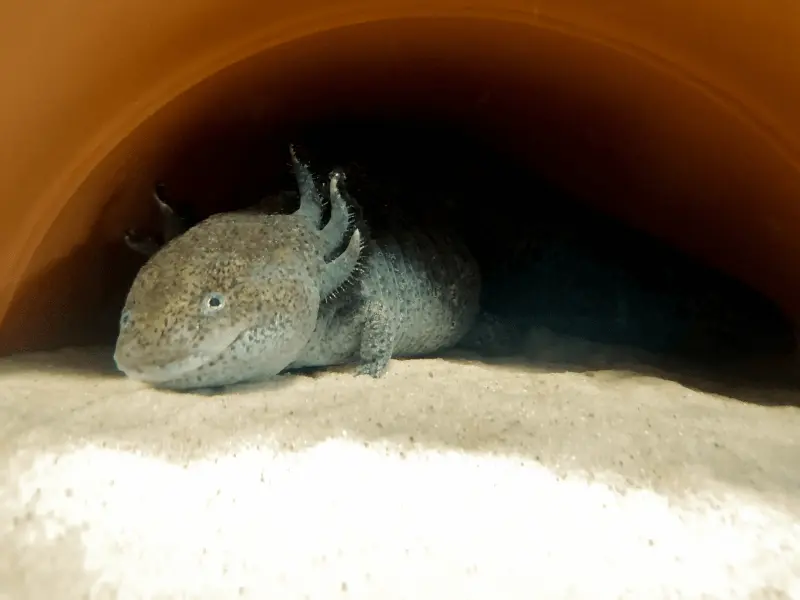
I have used a canister filter with a sponge filter for extra biological filtration and gentle bubbles. That gives me useful redundancy, but it also means I do not service both filters heavily on the same day. I spot clean visible waste, watch actual flow, test the water, and stagger equipment work.
The substrate changes the technique too. A bare bottom makes waste very easy to see. Fine sand looks more natural, but I siphon just above the surface and pay attention to low-flow areas and the edges of hides. Either way, the API test results tell me whether the routine is actually controlling waste.
Free one-page printable
Keep the routine beside the aquarium
The maintenance checklist includes daily, weekly, monthly, and as-needed tasks, a four-week routine tracker, water-test fields, and reminders about the cleaning mistakes that can disrupt a cycle.
Common maintenance questions
Quick answers before you reach for the siphon
How often should I clean an axolotl tank?
Observe and spot clean daily, test the water weekly, and begin with a planned weekly partial water change. Adjust the interval using nitrate trends, visible waste, aquarium volume, stocking, feeding, and equipment performance.
Should I remove the axolotl during a water change?
Routine partial changes usually do not require removing the animal. Work calmly, keep siphon and equipment away from delicate gills and toes, and refill gently. Use a submerged container transfer when a genuinely disruptive task makes temporary removal safer.
How often should I clean the filter?
Service it when flow declines, debris accumulates, operation changes, or the manufacturer’s schedule calls for inspection. Do not replace every mature media section at once.
Do I still need a weekly change when nitrate is low?
A regular partial-change routine also dilutes dissolved waste that a basic nitrate test does not measure. Use the result to refine the schedule, not as the only reason to maintain or ignore the aquarium.
Why test before the water change?
The pre-change result shows what accumulated during the interval. A post-change test can confirm a correction, but by itself it may hide how high nitrate or another parameter became before maintenance.
What if the water becomes cloudy?
Test ammonia, nitrite, nitrate, pH, and temperature first. Review feeding, decaying material, filter flow, recent cleaning, and whether the aquarium is fully cycled. Cloudiness is a clue, not a diagnosis.
Sources and further reading
- LafeberVet: Basic information sheet - axolotl
- LafeberVet: Care of the Axolotl
- API: Freshwater Master Test Kit
- OATA: How to look after axolotls and aquatic frogs
- Ambystoma Genetic Stock Center: Guide to axolotl husbandry
- Merck Veterinary Manual: Housing for amphibians
- Axolotl Authority: Water parameters guide
This independently written educational guide combines published husbandry guidance with Pat’s keeper experience. It does not replace current product directions or veterinary advice for an unwell animal.