
Choose by nutrition, source, and size
Best Worms for Axolotls: Safe Options and Feeding Tips
Truth be told, the worm aisle is more confusing than it needs to be. For many juvenile and adult axolotls, responsibly sourced earthworm portions are the most useful place to start. Other worm foods can still have a role, but they are not all interchangeable.
The source matters as much as the worm name
Do not collect feeding worms from lawns, gardens, parks, compost piles, or soil that may contain pesticides, herbicides, fertilizers, animal waste, road runoff, or other contaminants. Use a reputable vermiculture or food supplier and ask exactly how the worms were raised and packaged.
The straightforward version
Start with earthworm portions for most juveniles and adults
Earthworms are repeatedly included in veterinary and research-colony feeding guidance, and Merck notes that earthworms are an exception to the unfavorable calcium-to-phosphorus balance found in many invertebrate prey items.
I would not turn that into “every worm is safe in every amount.” Trade names vary, sources vary, and a thick whole nightcrawler is very different from a small red wiggler. Rinse the worm, cut an appropriate portion with clean dedicated scissors, and observe the animal while it swallows.
Not every “worm” is an earthworm
How the common options compare
Bloodworms are midge larvae, blackworms are aquatic annelids, and mealworms are beetle larvae. The common names may sound similar, but the animals and their feeding roles are different.
Nightcrawlers and other earthworms
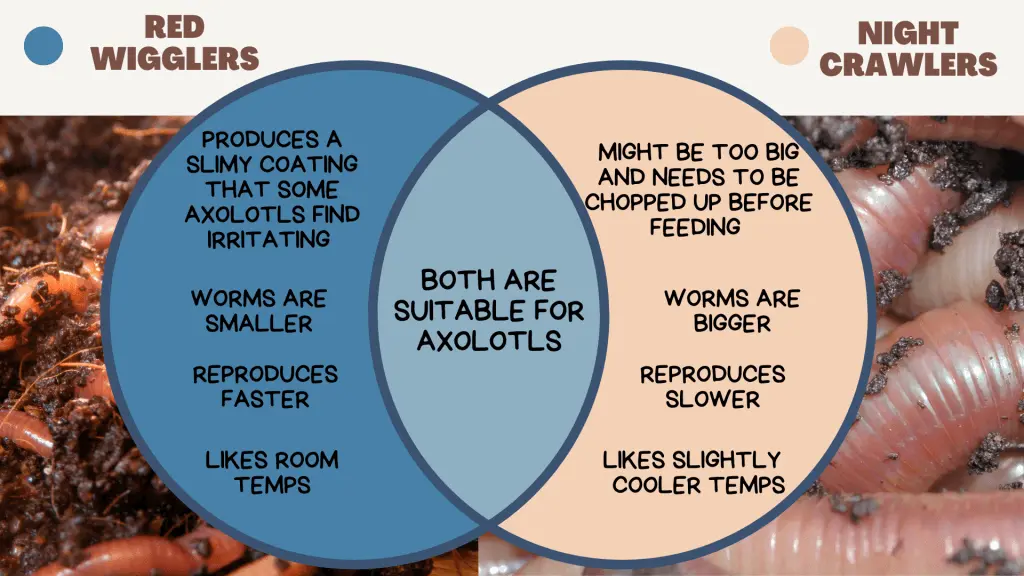
Nutritious, widely accepted, and easy to portion. Confirm the source and cut long or thick worms before feeding.
Red wigglers
Smaller earthworms that are practical for home cultures. Some axolotls reject their defensive secretion, so acceptance varies.
Blackworms
Appropriately sized for many larvae and juveniles. Use a dependable cultured source and manage live food carefully.
Bloodworms
Convenient frozen midge larvae that can add variety or help with a transition. Do not let one easy food crowd out a balanced diet.
Tubifex worms
Listed in veterinary feeding guidance, but source and handling are important. I would choose a reputable cultured or frozen product.
Mealworms
They are hard-bodied terrestrial beetle larvae rather than aquatic worms. Better, easier-to-swallow foods are available.
The most useful feeding worms
Nightcrawlers and red wigglers each have advantages
Larger and easy to divide
“Nightcrawler” may refer to Canadian, European, or other earthworms. They can provide convenient portions for larger axolotls, but the package name alone does not identify the exact species or how it was raised.
Because axolotls suction-feed rather than chew, I cut long or thick worms into manageable pieces. LafeberVet specifically recommends portions after a published report of stomach perforation in two tiger salamanders that consumed whole live nightcrawlers.
Smaller and easy to culture
Red wigglers are surface-dwelling compost worms, which is why they work so well in a home worm bin. They are convenient for smaller portions and reproduce readily under suitable conditions.
They can release a defensive coelomic fluid when disturbed. Some axolotls eat them without hesitation, while others spit them out. Rinse the worm and try a smaller piece. If it is repeatedly refused, choose another suitable worm or pellet instead of turning every meal into a battle.
Blackworms, bloodworms, and tubifex
These foods can be useful, but they fill different roles
Very young axolotls need food that moves and fits into a tiny mouth. As the animal grows, the diet and portion size should grow with it. Follow the breeder’s exact plan for hatchlings instead of applying an adult worm guide to larvae.
Live blackworms can trigger a strong feeding response, while frozen products can be easier to store. Buy from a dependable cultured source, offer a controlled amount, and remove worms that are not eaten.
Frozen bloodworms are easy to portion and are included in veterinary axolotl food lists. I use them as a supplement or transition food rather than the only food offered to a growing juvenile or adult.
Tubifex also appear in veterinary feeding guidance. Because live aquatic prey can carry organisms from its source, a cultured or properly frozen product is a more conservative choice than worms collected from unknown water.
Thaw frozen food outside the aquarium. Use a clean cup with a small amount of aquarium water, offer only the portion you need, and discard the thawing liquid. Do not refreeze thawed food.
Where I would buy worms
Choose a supplier that can answer basic questions
A local aquarium shop, responsible vermiculture supplier, or established online seller can all work. Bait shops are more variable. Some sell clean cultured worms, while others cannot tell you whether the product was exposed to attractants, dyes, pesticides, or other treatments.
Vermiculture supplier
Ask for the scientific name, culture conditions, bedding, and storage instructions.
Aquarium store
Look for healthy stock, clear labeling, refrigerated or frozen storage as appropriate, and knowledgeable staff.
Bait shop
Confirm the worms are cultured, untreated, correctly stored, and intended to remain alive, not preserved or enhanced.
Outdoor collection
You usually cannot verify chemical exposure, animal waste, runoff, soil contaminants, or the exact species.
From container to aquarium
Prepare each earthworm in five simple steps
You do not need a complicated ritual. Clean tools, a safe source, sensible portions, and prompt cleanup do most of the work.
- 1Choose an active worm
Discard worms that smell foul, look decomposed, or came from a failed or contaminated culture.
- 2Rinse away bedding
Use cool, clean water and remove every visible piece of soil, coir, food, or castings.
- 3Cut a manageable portion
Use clean dedicated scissors. Consider the worm’s thickness and length along with the axolotl’s size and normal swallowing ability.
- 4Offer and observe
Use blunt feeding tongs or the normal feeding area. Release the food when the axolotl takes it and never pull against the animal.
- 5Remove leftovers
Collect rejected pieces before they disappear under decor and begin affecting water quality.
Food I would leave out
A familiar pet-store food is not automatically appropriate
Mealworms and superworms have hard exoskeletons and are designed for animals that process terrestrial insects differently. Wild worms and unknown bait are impossible to trace. Old dead worms can decompose quickly. There are enough safer choices that none of these risks adds much value.
- Mealworms and superworms
Hard-bodied beetle larvae and a poor fit for routine axolotl feeding.
- Wild-collected worms
Unknown chemical, waste, runoff, parasite, and species history.
- Preserved or enhanced bait
Products with dyes, scents, salt, preservatives, or other additives.
- Worms found dead
Unknown time and cause of death, with a growing bacterial and decomposition risk.
Common questions
Axolotl worm-feeding FAQ
Should I feed a whole nightcrawler?
I recommend cutting long or thick nightcrawlers into portions. This makes the serving easier to size and follows the conservative veterinary warning published by LafeberVet.
Do red wigglers need to be blanched?
No. Rinse one thoroughly and offer a small portion first. Brief blanching is often suggested when an axolotl dislikes the defensive secretion, but it is not necessary for every worm. A different suitable earthworm or sinking pellet is simpler when rejection continues.
Can bloodworms be the only food?
I would not use one frozen food as the complete long-term diet for a growing juvenile or adult. Veterinary guidance calls for a varied and balanced diet. Use the complete feeding guide to combine appropriate foods and track body condition.
Can I feed frozen or dead worms?
A commercially frozen product can be used according to its storage and thawing instructions. A freshly cut earthworm portion is also no longer alive. Do not feed a worm that was found dead or has been sitting warm because you cannot judge its condition safely.
Can I use worms from my garden?
I do not recommend it. Even when you have not personally sprayed the area, drift, runoff, fertilizer, treated plants, animal waste, prior property use, and an unknown worm species can complicate the risk.
Why did my axolotl suddenly stop eating worms?
Test temperature, ammonia, nitrite, nitrate, and pH first. Review recent changes, swallowed hazards, body condition, behavior, and how long the refusal has continued. Contact an aquatic or exotic veterinarian when appetite loss persists or appears with weight loss, swelling, abnormal buoyancy, skin or gill changes, sores, vomiting, or lethargy.
Sources and further reading
- LafeberVet: Basic Information Sheet: Axolotl
- LafeberVet: Care of the Axolotl
- Ambystoma Genetic Stock Center: Guide to Axolotl Husbandry
- Ambystoma Genetic Stock Center: Food
- Merck Veterinary Manual: Noninfectious Disorders of Amphibians
- OATA: How to Look After Axolotls and Aquatic Frogs
- Oregon State University Extension: Composting with Worms
This independently written guide combines published feeding and nutrition guidance with Pat’s firsthand worm-bin and feeding experience. Individual needs vary, and persistent appetite or body-condition changes deserve qualified veterinary guidance.